
Which problem do you actually have?
Before comparing devices, work out what you’re looking at in the mirror.
| What you see | What it is | Likely treatment |
|---|---|---|
| Jawline softening, jowls, loose skin under chin | Laxity, structural | XERF |
| Brown spots, freckles, sun damage on cheeks | Epidermal pigment | PicoSure Pro |
| Symmetrical brown-grey patches on cheeks/forehead/upper lip | Melasma often chronic | PicoSure Pro + topicals + photoprotection |
| Dark marks left behind after acne or injury | Post-inflammatory hyperpigmentation | PicoSure Pro (conservative settings) |
| Pitted or indented acne scarring | Atrophic scarring, textural | PicoSure Pro (Platinum Focus lens) |
| Dull, tired, rough-looking skin | Texture + tone | PicoSure Pro |
| Fine lines with no real sagging | Early photoaging | Either — depends on the rest of your skin |
| Hollowing, flattening of the cheeks | Volume loss | Neither — this needs filler or biostimulators |
| Skin looks “heavy,” fold under the jaw | Moderate-to-severe laxity | Neither — surgical consult |
If you’re in the last two rows, an honest provider will tell you a device isn’t your answer. We will.
When patients search for advanced skin rejuvenation in San Gabriel, Los Angeles, Monterey Park, Pasadena, Alhambra, Arcadia and the greater San Gabriel Valley, two treatments come up repeatedly: XERF radiofrequency skin tightening and PicoSure Pro laser treatment.
Both are non-surgical. Both improve how skin looks. But they are not interchangeable, and choosing wrong is an expensive way to be disappointed.
This guide explains what each one does, what each is actually cleared to treat, what they cost, who they suit, how to sequence them if you need both, and importantly for our community how pigmentation treatment should be handled in Fitzpatrick III–V skin.
A note worth knowing: both devices are made by the same manufacturer, Cynosure Lutronic. They were designed as complementary tools, not competitors.
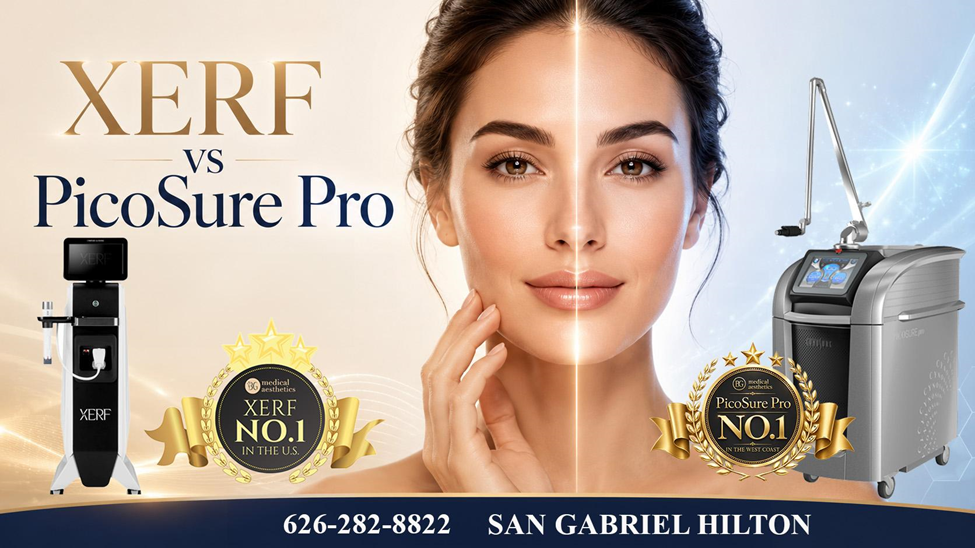
XERF vs PicoSure Pro at a Glance
| XERF | PicoSure Pro | |
|---|---|---|
| Manufacturer | Cynosure Lutronic | Cynosure Lutronic |
| Technology | Dual-frequency monopolar radiofrequency | 755 nm picosecond alexandrite laser |
| Energy mechanism | Controlled heating (thermal) | Ultra-short pulses creating pressure (photomechanical) |
| Specifications | 6.78 MHz + 2 MHz, three depth settings | Pulses in trillionths of a second; optional 532 nm and 1064 nm add-ons |
| Primary target | Collagen and deep structural layers | Melanin, pigment particles, tattoo ink |
| What it fixes | Laxity, sagging, contour, firmness | Dark spots, melasma, acne scars, tone, texture, tattoos |
| What it will not fix | Pigmentation, dark spots, tattoo ink | Sagging skin, jowls, laxity |
| U.S. FDA clearance | Electrocoagulation and hemostasis in dermatologic and general surgical procedures (K251327, Aug 2025) | Tattoo and benign pigmented lesion removal including melasma pigment, nevus of Ota and Hori’s macules; atrophic acne scars; wrinkles |
| Sensation | Deep, moving warmth | Quick snapping or rubber-band flick |
| Numbing | Usually not needed | Topical numbing commonly used |
| Session length | ~30–45 minutes | ~15–30 minutes for most facial treatments |
| Typical sessions | Often 2, spaced 4–6 weeks | Often 3–5, spaced 4–6 weeks (more for tattoos) |
| Downtime | Essentially none | Minimal; redness, “peppering”/bronzing, light flaking for a few days |
| Results appear | Some same-day; collagen from ~4–6 weeks | Brightening within 1–2 weeks; peak ~10–16 weeks |
| Typical U.S. cost | ~$1,500–$3,000/session | ~$400–$1,000+/session; packages of 3 commonly $1,500–$2,250 |
| Safe across skin tones | Yes — RF does not target melanin | Yes with correct settings — 755 nm has a favorable melanin-to-blood absorption ratio, but operator skill matters more here than with RF |
| Best for | Structure | Color and surface |
The Simplest Way to Tell Them Apart
XERF changes the shape of your face. PicoSure Pro changes the color and quality of your skin.
A patient can have flawlessly even skin tone and a sagging jawline. Another can have a razor-sharp jawline and heavy melasma. These are unrelated problems in different tissue layers, and no single device addresses both well.
Structure vs Color: The Mirror Test
Stand in front of a mirror in natural light and try this:
For structure: Lie down, or gently lift the skin at your temples and jawline with your fingertips. If lying back or lifting makes you look noticeably better, you have a laxity component that’s XERF territory.
For color: Look at your skin without makeup and squint slightly so detail blurs. If what remains is patchiness, brown patches, or an overall muddy tone rather than shadow and sag, you have a pigment component that’s PicoSure Pro territory.
Most patients over 40 have some of both. That’s normal, and it’s why combination planning exists.
What Is XERF Skin Tightening?
XERF is an advanced, non-invasive radiofrequency treatment designed to tighten and firm skin without surgery, needles or significant downtime. It’s made by Cynosure Lutronic, launched in South Korea in 2024, and received FDA clearance in the U.S. in August 2025.
How XERF Works
XERF is the first monopolar radiofrequency system to fire two frequencies simultaneously:
- 6.78 MHz — treats the upper dermis, where surface texture and fine lines sit
- 2 MHz — reaches deeper, toward the fibrous septa and the superficial musculoaponeurotic system (SMAS), the connective-tissue layer surgeons address in a facelift
Heat does two separate things here. Existing collagen fibers contract when heated, producing tightening some patients see the same day. Then, over the following weeks, the controlled thermal signal prompts fibroblasts to build new collagen. The first effect is temporary. The second is what lasts.
Integrated cryogen cooling protects the skin surface while heat builds underneath, which is why most patients don’t need numbing cream. Real-time impedance feedback reads tissue resistance and adjusts output, with three depth settings and ten intensity levels, so a thin temple and a dense jawline aren’t treated identically.
What XERF Is FDA-Cleared For
Precision matters here, so here’s the accurate version.
XERF was cleared through the FDA’s 510(k) pathway in August 2025 (K251327) as a Class II device, found substantially equivalent to predicates including Thermage FLX and truSculpt iD. Its cleared indication is for use in dermatologic and general surgical procedures for electrocoagulation and hemostasis. Cynosure Lutronic’s own materials state that when “skin tightening” is used in relation to XERF, it describes tightening that occurs via soft tissue coagulation.
In plain terms: XERF is a legally marketed, FDA-cleared device that clinicians commonly use for aesthetic tightening. It does not currently carry a dedicated cosmetic lifting indication the way some competing platforms do. Using a cleared device for an aesthetic application is ordinary dermatologic practice but you deserve to know that “FDA-cleared device” and “FDA-cleared for lifting” are different sentences. We tell patients this at consultation.
What XERF May Help Improve
- Mild to moderate skin laxity
- Loose or sagging skin on the lower face and neck
- Jawline definition and facial contour
- Fine lines and wrinkles
- Facial firmness and skin elasticity
- Early signs of aging, including preventatively
- Laxity following significant weight loss
Because XERF works below the surface, it suits patients whose skin looks less firm, less lifted or less defined than it used to — not patients whose main complaint is color.
Key Benefits of XERF
- Non-invasive; no needles or incisions
- No surgical recovery
- Lifts and firms; supports collagen remodeling
- Improves facial contour and jawline definition
- Generally comfortable; usually no numbing required
- Minimal to no downtime for most patients
- Does not target melanin, so pigmentation risk is low across skin tones
- Natural-looking result without fillers or surgery
What Is PicoSure Pro?
PicoSure Pro is an advanced 755 nm picosecond alexandrite laser used to treat pigmentation, discoloration, acne scars and overall skin tone. It’s the successor to the original PicoSure the world’s first 755 nm picosecond laser and was launched by Cynosure in 2022.
How PicoSure Pro Works: Pressure Instead of Heat
This is the key conceptual difference from older lasers, and it’s why PicoSure Pro behaves differently in deeper skin tones.
Traditional pigment lasers work primarily through heat. They deliver energy over nanoseconds, heating pigment until it breaks apart and heating surrounding tissue along with it. That collateral heat is what drives redness, downtime and, in melanin-rich skin, the risk of post-inflammatory hyperpigmentation.
PicoSure Pro delivers energy in picoseconds trillionths of a second. The pulse is so short that pigment shatters through a photomechanical (pressure) effect rather than sustained heating. Less heat in the tissue means less inflammation, less downtime, and a lower risk of the rebound pigmentation that makes laser treatment risky in darker skin.
The 755 nm wavelength also has a favorable absorption profile — roughly three times greater absorption by melanin than by blood which reduces redness and hypopigmentation risk while still reaching pigment effectively.
The Two Lenses: Flat Lens vs Platinum Focus
PicoSure Pro isn’t one treatment. The handpiece lens changes what the device does, and this distinction is worth understanding before you book.
Flat lens, pigment clearance. Used to target unwanted epidermal and dermal pigment: sunspots, freckles, melasma, nevus of Ota, Hori’s nevus. This is the pigment-clearing mode.
Platinum Focus™ lens array, skin revitalization. Concentrates energy into microscopic high-intensity zones that create photomechanical reactions in the epidermis, signalling the dermis to produce new collagen and elastin. This is the mode used for acne scars, fine lines, pores and overall texture, with no downtime.
A well-planned treatment often uses both across a series. If a clinic can’t tell you which lens they’re using on you and why, that’s a signal.
What PicoSure Pro Is FDA-Cleared For
PicoSure Pro is indicated for tattoo removal and removal of benign pigmented lesions, including melasma pigment, nevus of Ota and Hori macules (nevus of Hori), it is the first and only picosecond device cleared for these specific pigment conditions. It also carries clearance covering atrophic acne scars and wrinkles.
The 755 nm wavelength targets black, blue and green tattoo inks. Optional 532 nm and 1064 nm add-ons extend coverage to “sunset colors” red, yellow and orange which are historically difficult to clear.
What PicoSure Pro May Help Improve
- Sunspots and solar lentigines
- Freckles (ephelides)
- Melasma and stubborn pigmentation
- Post-inflammatory hyperpigmentation
- Nevus of Ota and Hori’s nevus
- Acne scars, particularly atrophic scarring
- Uneven skin tone and dull complexion
- Enlarged pores and skin texture
- Fine lines and wrinkles
- Tattoo pigment
Key Benefits of PicoSure Pro
- Targets pigmentation and dark spots precisely
- Improves acne scars and uneven texture
- Brightens dull skin and improves radiance
- Uses pressure rather than heat, reducing thermal injury
- Lower risk of post-inflammatory hyperpigmentation than older nanosecond lasers
- Appropriate across all Fitzpatrick skin types with correct parameters
- Minimal downtime for most patients
- Doubles as an effective tattoo removal platform
- The most clinically published picosecond platform, with an extensive study library
Choose XERF If You Want Skin Tightening and Lifting
XERF may be the better option if you’re searching for:
- XERF skin tightening in San Gabriel
- Non-surgical face lifting near Los Angeles
- RF skin tightening in the San Gabriel Valley
- Jawline tightening without surgery
- Skin firming near Pasadena, Alhambra, Arcadia or Monterey Park
You’re likely a good candidate if you notice firmness loss around the cheeks, jawline, lower face or neck; you have mild to moderate laxity; you want preventative tightening before laxity advances; and your skin tone is relatively even.
XERF will not help if your primary complaint is dark spots, melasma or acne scarring. It does not target pigment.
Choose PicoSure Pro If You Want Brighter, Clearer Skin
PicoSure Pro may be the better option if you’re searching for:
- PicoSure Pro laser in San Gabriel
- Laser treatment for dark spots near Los Angeles
- Acne scar laser treatment in the San Gabriel Valley
- Melasma treatment near Pasadena or Alhambra
- Pigmentation laser near Monterey Park
- Nevus of Ota or Hori’s nevus treatment in Los Angeles County
- Tattoo removal in the San Gabriel Valley
You’re likely a good candidate if your main concern is discoloration, acne scars, sun damage, freckles, melasma or dullness, and you want a more even, refined complexion.
PicoSure Pro will not lift sagging skin. It improves the surface, not the structure.
Pigmentation Treatment for Asian and Deeper Skin Tones
This section matters more than any other on this page for our community, and most treatment pages skip it entirely.
Why Fitzpatrick III–VI Skin Needs a Different Approach
San Gabriel’s population is roughly 60% Asian, and the surrounding San Gabriel Valley communities Monterey Park, Alhambra, Arcadia, Temple City, Rosemead, San Marino are similar. Most of our patients fall into Fitzpatrick skin types III through V.
Peer-reviewed dermatology literature is direct about this: treating pigmentary disorders in Asian skin is more difficult, because higher baseline melanin content is associated with a higher incidence of laser complications burns, hyperpigmentation, hypopigmentation and textural change. Reviews of picosecond laser use in Asian patients specifically note these risks, alongside evidence that picosecond technology achieves better effectiveness with potentially fewer complications than older nanosecond lasers, precisely because of its photomechanical rather than purely thermal mechanism.
What this means practically:
- Conservative settings beat aggressive ones. More energy is not better in melanin-rich skin. It’s how you get PIH.
- More sessions at lower fluence generally outperforms fewer aggressive sessions.
- Test spotting is not optional. Neither is baseline photography.
- Pre- and post-treatment topical support matters as much as the laser. Tranexamic acid, niacinamide, azelaic acid and — where appropriate and physician-directed hydroquinone.
- Photoprotection is the treatment, not an afterthought. Broad-spectrum SPF 30+ daily, and ideally a tinted mineral sunscreen with iron oxides, because visible light drives pigment in deeper skin types and clear chemical sunscreens don’t block it.
- Provider experience with your skin type is a legitimate screening question. Ask it.
Melasma: What PicoSure Pro Can and Cannot Do
Melasma deserves an honest section because it’s the most commonly over-promised condition in aesthetics.
What melasma is: symmetrical brown or grey-brown patches, usually on the cheeks, forehead, upper lip and around the eyes. It’s driven by overstimulated melanocytes, and it’s multifactorial hormones, genetics, UV radiation, visible light, heat, certain medications including oral contraceptives, and stress all contribute. It’s particularly challenging in Asian skin, where increased melanocyte activity and heightened PIH susceptibility make it chronic and recurrent.
What the evidence shows. PicoSure Pro is the only picosecond device FDA-cleared to treat melasma pigment. A one-year prospective cohort study of picosecond laser with a diffractive lens array in melasma patients found MASI scores decreased significantly and continued to improve through the 12-month follow-up, with wrinkles and vascularity improving alongside and, importantly, no post-inflammatory hyperpigmentation or hypopigmentation occurred. That’s a strong safety signal.
What the same evidence also shows. Improvements in spots, texture, pores, UV spots and brown spots relapsed by the one-year mark. The study authors recommend follow-up visits every three to six months.
So here is the honest framing:
Melasma is managed, not cured. PicoSure Pro can meaningfully reduce it, and the published safety data in melanin-rich skin is genuinely reassuring. But melasma developed over months or years, and it will return without ongoing photoprotection, topical maintenance and periodic follow-up. Any clinic that promises to eliminate your melasma permanently is overselling. Repeated aggressive laser exposure over years carries its own cumulative risks, including mottled depigmentation and rebound pigmentation.
Realistic expectation: meaningful, visible improvement over a series of sessions, maintained by a long-term plan. Not a one-time fix.
Nevus of Ota and Hori’s Nevus
These are dermal melanocytic conditions considerably more common in East Asian patients than in the general U.S. population, and both are specifically named in PicoSure Pro’s FDA clearance.
Nevus of Ota presents as blue-grey or brown pigmentation, typically unilateral, around the eye, temple and forehead, following the trigeminal nerve distribution. Often present from birth or early life.
Hori’s nevus (acquired bilateral nevus of Ota-like macules) presents as bilateral blue-brown or slate-grey speckled patches over the cheekbones, usually appearing in adulthood. It’s frequently mistaken for melasma and treated as melasma, unsuccessfully because they occupy similar territory on the face.
Getting the diagnosis right changes everything. Hori’s nevus is dermal; melasma is mixed epidermal and dermal. They respond to different parameters and follow different treatment courses. If you’ve been treated for melasma repeatedly without improvement, it’s worth asking whether the diagnosis is correct.
Both conditions typically require a series of treatments, and both are areas where picosecond technology has meaningfully outperformed older lasers.
Post-Inflammatory Hyperpigmentation (PIH)
PIH is the dark mark left behind after acne, an injury, an ingrown hair, eczema or an aggressive cosmetic treatment. It’s far more common and more persistent in Fitzpatrick III–VI skin.
PicoSure Pro can treat PIH, but two cautions apply:
- Treat the cause first. Lasering PIH from active acne while the acne is still active is treating a symptom while the cause keeps producing more.
- PIH can be caused by laser. This is the central irony of pigment treatment in deeper skin tones and precisely why conservative parameters and operator experience matter so much.
Why We Test-Spot Before Treating
For any patient with Fitzpatrick IV or above, or any patient with melasma or a PIH history, a test spot in a discreet area 2–4 weeks before full treatment is good practice. It costs one appointment and reveals how your skin actually responds which no consultation can predict with certainty.
We’d rather spend an extra visit than create a pigment problem that takes months to resolve. If a clinic proposes full-face laser on Fitzpatrick IV+ skin at your first visit with no test spot and no baseline photography, ask why.
Can You Combine XERF and PicoSure Pro?
Yes, and for many patients over 40 it’s the more complete approach, because aging happens in multiple layers simultaneously. Structural laxity sits deep; pigment and texture sit at the surface. Treating one and ignoring the other leaves an obviously incomplete result.
A customized combination plan may include:
- PicoSure Pro to improve pigmentation, clarity, acne scars and texture
- XERF to tighten, lift and support collagen remodeling
Why They Are Not Done on the Same Day
Stacking two energy modalities in one session compounds inflammation, makes it impossible to identify which treatment caused any adverse reaction, and in melanin-rich skin meaningfully raises PIH risk. Providers typically space them by at least 2–4 weeks, and often longer.
A Sample Combination Timeline
This is illustrative, not prescriptive. Your plan should be built around your skin.
| Timing | Treatment | Purpose |
|---|---|---|
| Week 0 | Consultation, photography, test spot if indicated | Baseline and safety |
| Weeks 0–4 | Topical prep (photoprotection, pigment-directed actives) | Prime the skin, reduce PIH risk |
| Week 4 | PicoSure Pro session 1 | Begin pigment clearance |
| Week 8 | PicoSure Pro session 2 | Continue |
| Week 12 | PicoSure Pro session 3 | Continue |
| Week 16 | XERF session 1 | Begin structural tightening |
| Week 20–22 | XERF session 2 | Complete tightening protocol |
| Week 28+ | Reassess; maintenance PicoSure Pro as needed | Manage recurrence |
The Melasma Exception: When Heat Is a Problem
This is the most important paragraph on this page, and it’s the one most competing pages omit.
Melasma is triggered by heat, not just ultraviolet light. XERF is a heat-based radiofrequency treatment. For a patient with active or unstable melasma, aggressive RF heating over affected areas carries a real theoretical risk of aggravating the pigment.
That doesn’t rule out combining them. It means the plan changes:
- Stabilize the melasma first with photoprotection and topical therapy before introducing any heat-based device
- Use conservative RF parameters over melasma-prone zones, cheeks, forehead, upper lip
- Consider treating laxity zones that don’t overlap the melasma pattern, such as the jawline, submental area and neck
- Maintain strict photoprotection throughout, including a tinted mineral sunscreen
- Space treatments generously and reassess pigment before each session
If you have melasma and a clinic recommends full-face radiofrequency without asking a single question about your pigment history, seek a second opinion. This is a real clinical consideration, not a technicality.
Which Treatment Should Come First?
The best order depends on your skin, your goals and your provider’s assessment. General principles:
Start with PicoSure Pro if pigmentation, sun damage, melasma or acne scars are your dominant concern; you have active melasma that needs stabilizing before heat is introduced; or your pigment is what you notice first in photographs.
Start with XERF if laxity and facial contour are your priority; your skin tone is relatively even; you have an event or timeline where visible lift matters; or your pigment concerns are mild.
A practical default for patients with both: address pigment first. Pigment issues are often what people actually see when they look at their face, improvement arrives sooner, and stabilizing pigment before introducing heat is the safer sequence — especially in Fitzpatrick III–V skin.
At BG Medical Aesthetics & Beautiful Glow, your plan is built after an in-person skin assessment, so we can evaluate your skin tone, texture, laxity, pigmentation pattern and long-term goals before recommending anything.
What to Expect: Before, During and After
Preparing for PicoSure Pro
- No sun exposure or tanning for 4 weeks before. Non-negotiable. Treating recently tanned skin substantially raises complication risk.
- No self-tanner for at least 2 weeks
- Stop retinoids and exfoliating acids 5–7 days before
- Disclose all medications several, including some antibiotics, diuretics and NSAIDs, are photosensitizing
- Disclose any history of cold sores; prophylactic antiviral medication may be prescribed for perioral treatment
- Disclose recent isotretinoin use
- Arrive with clean, product-free skin
- Insist on baseline photographs
Preparing for XERF
- Arrive with clean skin, no makeup or SPF in the treatment area
- Pause retinoids and acids 3–5 days before
- Skip alcohol for 24 hours
- Schedule at least 2 weeks after any neurotoxin or filler in the same area
- Disclose any implanted electronic device, metal implant or permanent filler in the treatment area
- Baseline photographs
During Your Session
PicoSure Pro: topical numbing is commonly applied and takes about 20–30 minutes to take effect. You’ll wear protective eyewear. The sensation is a quick snapping or rubber-band flick. Most facial treatments run 15–30 minutes. You may notice an immediate darkening or greyish “frosting” over treated spots this is expected.
XERF: conductive gel is applied and the handpiece glides across the area in passes, with depth and intensity adjusted zone by zone. Sessions run 30–45 minutes. You’ll feel warmth building and receding as the cooling cycles. Speak up if any area becomes genuinely uncomfortable settings should be adjusted, not endured.
Aftercare and the Results Timeline
PicoSure Pro:
- Days 1–3: mild redness and warmth, like a light sunburn. Treated spots may look darker or bronzed. Some patients notice a fine “peppering” appearance.
- Days 3–7: darkened pigment lifts and flakes away. Do not pick or scrub.
- Weeks 2–4: brightening becomes visible.
- Weeks 10–16: peak result from the series, as collagen and pigment changes complete.
- Ongoing: maintenance depends on the condition. Melasma in particular needs a long-term plan.
Aftercare essentials: strict sun avoidance and daily broad-spectrum SPF 30+ (tinted mineral preferred), gentle cleansing, bland moisturizer, no actives for 5–7 days, no picking, no saunas or hot yoga for 48 hours.
XERF:
- Immediately: possible mild redness or warmth, usually gone within hours. Makeup and normal activity same-day.
- Days 1–7: any same-day tightening may soften slightly. Expected, not treatment failure.
- Weeks 4–6: new collagen becomes visible; firmness and contour begin changing.
- Weeks 8–12: the point at which to evaluate. Take comparison photos in matched lighting.
- Months 3–6: peak result.
- Months 12–18: typical reassessment window.
Why Your Dark Spots Look Darker First
This surprises almost every first-time laser patient, so here it is plainly: treated pigment usually gets darker before it clears.
The laser shatters pigment and brings it toward the surface. For roughly three to seven days, spots may appear darker, greyish or bronzed, and then flake away as the skin turns over. This is the treatment working, not a complication.
What is normal: temporary darkening, mild redness, light flaking, a slightly rough texture.
What is not normal and warrants a call: blistering, open wounds, spreading redness, significant pain, or darkening that spreads well beyond the treated spots or persists past two to three weeks. Contact us at 626-282-8822 if you see any of these.
Who Is Not a Candidate?
Contraindications for PicoSure Pro
- Recent sun exposure or active tan in the treatment area
- Pregnancy or breastfeeding
- Active infection, open wounds or active cold sore in the area
- History of keloid or hypertrophic scarring
- Photosensitizing medications or photosensitivity disorders
- Recent isotretinoin use
- Certain autoimmune or connective tissue conditions
- Undiagnosed pigmented lesions, any lesion that has changed in size, shape, color or border must be evaluated by a physician before laser treatment. Lasers must never be used on suspicious lesions.
Contraindications for XERF
- Pregnancy or breastfeeding
- Pacemaker, ICD or other implanted electronic device, a specific concern with radiofrequency
- Metal implants or permanent dermal fillers in the treatment area
- Active infection or open wounds in the area
- History of keloid scarring
- Autoimmune or connective tissue disease
- Uncontrolled diabetes or impaired wound healing
- Active or unstable melasma in the treatment zone (see the melasma section above)
- Significant laxity where surgery would serve you better
Neither list is exhaustive, and neither substitutes for a medical consultation.
How These Compare to IPL, Fraxel, Morpheus8 and Ultherapy
| Treatment | Technology | Best for | Skin-tone consideration |
|---|---|---|---|
| XERF | Dual-frequency monopolar RF | Laxity, jawline, contour | Safe across tones; RF doesn’t target melanin |
| PicoSure Pro | 755 nm picosecond laser | Pigment, melasma, acne scars, tattoos, texture | Appropriate across tones with correct parameters |
| IPL / BBL | Broadband light | Sun damage, redness, vascular concerns | Generally not recommended for Fitzpatrick IV+ — significant PIH and burn risk |
| Fraxel | Fractional non-ablative laser | Texture, scarring, deeper resurfacing | Higher PIH risk in deeper tones; requires experienced hands |
| Morpheus8 | RF microneedling | Texture, scarring, laxity combined | Reasonable in deeper tones; has real downtime |
| Ultherapy / Sofwave | Ultrasound | Deep lifting; skin quality | Safe across tones |
One point worth emphasizing for our patient population: IPL is widely marketed for “sun spots” and is frequently the wrong choice for Fitzpatrick IV and above. Broadband light targets melanin indiscriminately, and in melanin-rich skin that means elevated risk of burns and post-inflammatory hyperpigmentation. If you have deeper skin and a clinic recommends IPL for pigmentation without discussing your skin type, that’s a meaningful red flag.
XERF vs PicoSure Pro: Which Is Better?
Neither is “better.” They’re built for different jobs.
- If you want a more lifted, firmer, tighter appearance — XERF.
- If you want brighter, clearer, more even-toned skin — PicoSure Pro.
- If you want both — a sequenced combination plan, with pigment generally addressed first.
- If your issue is volume loss or advanced laxity — neither. You need filler, biostimulators, or a surgical consultation, and we’ll say so.
The right answer comes from an in-person skin assessment, not a blog post. Including this one.
Why Choose BG Medical Aesthetics & Beautiful Glow?
Patients throughout San Gabriel, Los Angeles, Pasadena, Alhambra, Arcadia, Monterey Park, Temple City, Rosemead and the surrounding San Gabriel Valley choose us for advanced non-surgical aesthetic treatment.
Our approach focuses on:
- Personalized consultations with a real skin assessment, not a menu pitch
- Experience treating Fitzpatrick III–V skin, which is most of our community
- Conservative, staged protocols in melanin-rich skin
- Baseline photography and test spotting where indicated
- Natural-looking results
- Honest guidance about which treatment is right — including when the answer is neither
We don’t believe every patient needs the same treatment. Your skin, concerns and goals are unique, and your plan should be too.
Frequently Asked Questions
What’s the difference between XERF and PicoSure Pro?
XERF is a dual-frequency radiofrequency device that treats skin structure laxity, sagging, jawline definition. PicoSure Pro is a 755 nm picosecond laser that treats skin color and surface dark spots, melasma, acne scars, texture and tattoo ink. They address different problems in different skin layers and are not interchangeable.
Can I do XERF and PicoSure Pro together?
Yes, in a planned sequence but not on the same day. Stacking energy treatments compounds inflammation and, in deeper skin tones, raises the risk of post-inflammatory hyperpigmentation. Providers typically space them by at least two to four weeks.
Which should I do first, XERF or PicoSure Pro?
For most patients with both concerns, pigment first. Pigment is usually what people notice most, results arrive sooner, and stabilizing pigment before introducing a heat-based treatment is the safer sequence, particularly in Fitzpatrick III–V skin.
Is PicoSure Pro safe for Asian skin?
Yes, when parameters are set appropriately. Its picosecond pulses work through pressure rather than sustained heat, which reduces thermal injury and lowers PIH risk compared with older nanosecond lasers, and the 755 nm wavelength has a favorable melanin-to-blood absorption ratio. That said, Asian skin does carry a higher baseline risk of laser complications, so provider experience with your specific skin type matters more here than with radiofrequency.
Does PicoSure Pro treat melasma?
Yes — it’s the only picosecond device FDA-cleared to treat melasma pigment. Published one-year data shows significant, sustained improvement in melasma severity scores with no post-inflammatory hyperpigmentation or hypopigmentation. But melasma is chronic and recurrent: the same research found several pigment measures relapsed by twelve months and recommends follow-up every three to six months. Melasma is managed, not cured.
Can laser make melasma worse?
It can, with the wrong device or overly aggressive settings. Melasma is triggered by heat as well as UV light, so heat-heavy treatments carry risk. Picosecond lasers reduce that risk by working photomechanically rather than thermally, but conservative parameters, photoprotection and topical support remain essential.
Will XERF make my melasma worse?
Possibly, if it’s aggressive and your melasma is active or unstable. XERF is heat-based, and heat is a melasma trigger. This doesn’t rule out XERF, it means stabilizing pigment first, using conservative settings over melasma-prone areas, potentially focusing on non-overlapping zones like the jawline and neck, and maintaining strict photoprotection.
What is Hori’s nevus and can PicoSure Pro treat it?
Hori’s nevus, also called acquired bilateral nevus of Ota-like macules, produces bilateral blue-brown or slate-grey speckled patches over the cheekbones and typically appears in adulthood. It’s common in East Asian patients and is frequently misdiagnosed as melasma. PicoSure Pro is specifically FDA-cleared to treat both Hori’s nevus and nevus of Ota.
How many PicoSure Pro sessions will I need?
Most patients need three to five sessions spaced four to six weeks apart for pigmentation or texture. Simple, discrete spots may clear in one to three. Deeper melasma, dermal pigment conditions and tattoos require more, tattoos commonly need four to eight or more sessions depending on size, ink density and color.
How much does PicoSure Pro cost?
Published U.S. pricing generally runs $400–$1,000+ per session depending on area and concern, with three-session packages commonly $1,500–$2,250. XERF typically runs $1,500–$3,000 per session. Compare total protocol cost, not session price, and confirm what’s included.
Why do my dark spots look darker after treatment?
That’s expected. The laser shatters pigment and brings it toward the surface, so spots typically appear darker, greyish or bronzed for three to seven days before flaking away as skin turns over. Blistering, open wounds, spreading redness or darkening persisting beyond two to three weeks is not normal , contact your provider.
Does PicoSure Pro hurt?
Most patients describe a quick snapping sensation, like a rubber band flick. Topical numbing is commonly applied beforehand. Most facial sessions take fifteen to thirty minutes. XERF, by comparison, is a deep warmth and usually needs no numbing.
What’s the downtime?
XERF has essentially none. PicoSure Pro has minimal downtime, mild redness for a day or two, temporary darkening of treated spots, and light flaking over about a week. Most patients return to normal activities within twenty-four hours.
Can I wear makeup after?
After XERF, yes, same day. After PicoSure Pro, most providers advise waiting twenty-four hours, then using clean, non-irritating products over intact skin only.
Is either covered by insurance?
No. Both are cosmetic treatments and are paid out of pocket.
Who is not a candidate?
For PicoSure Pro: anyone with recent sun exposure or an active tan, pregnancy, active infection, photosensitizing medications, keloid history, or any undiagnosed or changing pigmented lesion, which must be evaluated by a physician first. For XERF: pregnancy, pacemaker or implanted electronic device, metal implants or permanent filler in the area, impaired wound healing, or laxity significant enough that surgery would serve better.
What if I have both sagging skin and pigmentation?
That’s the most common presentation over forty, and it’s exactly what combination planning is for. Typically pigment is addressed first over several sessions, then structural tightening, with maintenance for whichever concern is more recurrent.
Schedule a Consultation for XERF or PicoSure Pro in San Gabriel, CA
Still deciding? The only reliable way to know which treatment fits is an in-person assessment of your skin tone, texture, laxity and pigmentation pattern.
At BG Medical Aesthetics & Beautiful Glow in San Gabriel, CA, we’ll evaluate your skin and build a plan around your actual goals, and tell you honestly if neither device is the right route.
Whether you’re looking for XERF skin tightening near Los Angeles, PicoSure Pro laser treatment in San Gabriel, or a combination plan for full-face rejuvenation, call 626-282-8822 to book.