
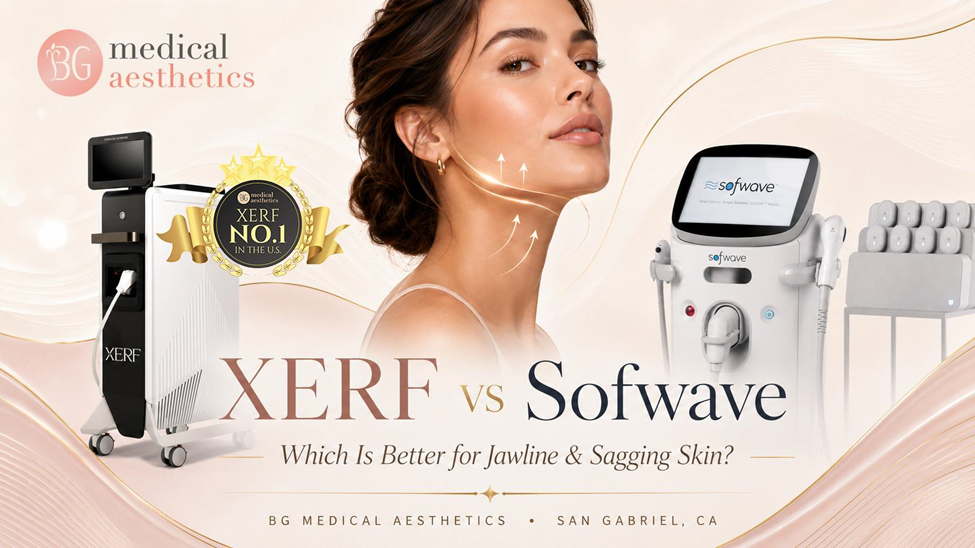
When it comes to non-surgical skin tightening, two treatments come up in almost every consultation: XERF and Sofwave.
Both are designed to improve skin laxity and support collagen production, but they work differently and are not always the right tool for the same goal. If your main concern is the jawline, lower face, early jowls, or sagging skin, understanding the difference between Sofwave and XERF will help you choose well and help you avoid paying four figures for the wrong treatment.
This guide covers how each device works, what each is actually cleared to do, what results look like at 1 day, 6 weeks and 6 months, what each costs, who is a candidate, and just as importantly who isn’t.
XERF vs Sofwave at a Glance
| XERF | Sofwave | |
|---|---|---|
| Manufacturer | Cynosure Lutronic | Sofwave Medical Ltd. |
| Energy type | Dual-frequency monopolar radiofrequency | Ultrasound (SUPERB™ parallel beam) |
| Frequencies | 6.78 MHz + 2 MHz simultaneously | Ultrasound array, 7 transducers |
| Treatment depth | Superficial, mid and deep — three depth settings | Fixed 1.5 mm, mid-dermis |
| Reaches SMAS layer | Manufacturer histology reports energy delivery to the SMAS | No, deliberately stays in the mid-dermis |
| U.S. FDA clearance | Electrocoagulation and hemostasis in dermatologic and general surgical procedures (K251327, Aug 2025) | Multiple aesthetic indications: fine lines and wrinkles, brow lift, submental lift, neck laxity, cellulite, acne scars, upper-arm laxity |
| Typical sessions | Often 2, spaced ~4–6 weeks | Often 1, occasionally 2 |
| Session length | ~30–45 minutes | ~30–45 minutes |
| Numbing | Usually not required | Topical numbing commonly used |
| Typical sensation | Deep, moving warmth; occasional “zings” near bone | Brief heat pulses; more intense per pulse |
| Downtime | Essentially none | Essentially none; possible transient swelling |
| Immediate visible change | Commonly reported | Uncommon; results are gradual |
| Peak results | ~6–12 weeks | ~12 weeks to 6 months |
| Duration | Commonly cited 12–18 months | Commonly cited 12–24 months |
| Typical U.S. cost | ~$1,500–$3,000/session; full face + neck often ~$2,500 | ~$500–$1,200 small area; ~$2,500–$4,500 full face + neck |
| Peer-reviewed evidence | Emerging; manufacturer-sponsored histology and Korean clinical studies | Larger published library including independent biopsy data |
| Best suited to | Jawline, jowls, lower-face and neck laxity; multi-zone contouring | Fine lines, brow lift, skin quality, submental and neck laxity |
Pricing reflects published U.S. clinic menus and industry reporting as of mid-2026 and varies by market, provider and treatment area. Ask for a written quote at consultation.
What Is XERF?
XERF is a non-invasive radiofrequency device made by Cynosure Lutronic that delivers controlled heat into the skin to stimulate tightening, firming and collagen remodeling. It launched in South Korea in 2024, where it became widely used before entering the U.S. market, and it received FDA 510(k) clearance in August 2025.
How XERF Works: Dual-Frequency Monopolar Radiofrequency
Most radiofrequency devices run at a single frequency, which means they concentrate energy at essentially one depth. XERF is the first monopolar RF system to fire two frequencies at once:
- 6.78 MHz — targets the upper dermis, where surface texture, fine lines and skin quality live.
- 2 MHz — travels deeper, toward the fibrous septa and the superficial musculoaponeurotic system (SMAS), the connective-tissue layer beneath the skin and fat that surgeons address during a facelift.
Heating tissue at these levels does two separate things. First, existing collagen fibers contract when heated to a therapeutic temperature, that’s the immediate tightening some patients notice walking out. Second, the controlled thermal injury signals fibroblasts to lay down new collagen over the following weeks. The first effect is temporary. The second is what actually holds.
Three technologies make higher energy tolerable:
- Integrated Cryogen Delivery (ICD) cooling protects the epidermis while heat builds underneath, which is why most patients don’t need numbing cream.
- Wave Fit™ pulse technology modulates how energy is released across the pulse.
- Impedance feedback reads tissue resistance in real time and adjusts output, so a thin temple and a dense jawline aren’t treated identically. The system offers three depth settings and ten intensity levels.
What XERF Is FDA-Cleared For
This is where most competing pages get sloppy, so here is the precise version.
XERF was cleared through the FDA’s 510(k) pathway in August 2025 (submission K251327) as a Class II device, found substantially equivalent to predicate devices including Thermage FLX and truSculpt iD. Its cleared indication is for use in dermatologic and general surgical procedures for electrocoagulation and hemostasis. Cynosure Lutronic’s own materials state that when the term “skin tightening” is used in relation to XERF, it describes tightening effects that occur via soft tissue coagulation.
What that means in plain English: XERF is a legally marketed, FDA-cleared device, and clinicians commonly use it for aesthetic tightening. But it does not currently hold a dedicated cosmetic lifting indication the way some competing platforms do. Using a cleared device for an aesthetic application is ordinary, accepted practice in dermatology, but you deserve to know the difference between “FDA-cleared device” and “FDA-cleared for lifting,” because they are not the same sentence.
We tell patients this at consultation. Any clinic that won’t is selling, not advising.
What XERF Treats
At BG Medical Aesthetics in San Gabriel, XERF is most often used to address:
- Jawline definition and lower-face contour
- Early jowls and lower-face sagging
- Cheek firmness and midface support
- Neck and submental laxity
- Fine lines and crepey texture
- Overall skin firmness following weight loss
XERF can also be applied to non-facial areas with laxity, including the upper arms, abdomen and above the knees.
What Is Sofwave?
Sofwave is a non-invasive ultrasound-based skin tightening treatment from Sofwave Medical. It has been on the U.S. market considerably longer than XERF and has accumulated a correspondingly larger body of published data.
How Sofwave Works: SUPERB Ultrasound Technology
Sofwave uses SUPERB™ Synchronous Ultrasound Parallel Beam technology. Cooled transducers sit directly against the epidermis and fire parallel ultrasound beams simultaneously, creating a three-dimensional array of controlled thermal zones at a fixed depth of 1.5 mm in the mid-dermis.
That depth is a deliberate design decision, not a limitation. The mid-dermis is where collagen and elastin are manufactured, so heating exactly there triggers a strong fibroblast response while leaving the epidermis and deeper fat undisturbed. It also makes the treatment predictable across skin tones, because ultrasound at that depth is not absorbed by melanin the way some light-based energy is.
The fractional heating pattern treated zones interspersed with untreated tissue is what allows the skin to heal quickly with effectively no downtime.
What Sofwave Is FDA-Cleared For
Sofwave holds a set of aesthetic FDA clearances, including:
- Improvement in fine lines and wrinkles
- Lifting the eyebrow
- Lifting lax submental (under-chin) tissue
- Lifting lax neck tissue
- Improvement in the appearance of cellulite (short-term)
- Improvement in the appearance of acne scars
- Improvement in the appearance of skin laxity on the upper arms
Sofwave also has independent biopsy-based evidence. A 2022 study published in Lasers in Surgery and Medicine (Wat et al.) reported measurable increases in collagen and elastin after a single treatment, verified by tissue sampling rather than photographs alone. That kind of histologic evidence is uncommon in aesthetics and is a legitimate point in Sofwave’s favor.
What Sofwave Treats
- Fine lines and wrinkles across the face
- Brow position and upper-face heaviness
- Submental (under-chin) laxity
- Neck laxity and horizontal neck lines
- Overall skin quality and texture
- Acne scarring
- Upper-arm laxity and cellulite appearance
XERF vs Sofwave: The 7 Key Differences
1. Energy Type: Radiofrequency vs Ultrasound
XERF uses radiofrequency electrical energy that meets resistance in tissue and converts to heat. Because RF heating depends on tissue impedance rather than a focal point, it produces broader, more volumetric warming, and the depth is controlled by frequency and device settings.
Sofwave uses ultrasound mechanical sound-wave energy focused to deposit heat at one predetermined depth.
Neither is inherently superior. They’re different instruments for different jobs. RF is generally better at broad structural warming across a contour; focused ultrasound is generally better at precise, repeatable deposition at a known depth.
2. Treatment Depth
This is the single most practically important difference for jawline patients.
Sofwave treats at 1.5 mm. That is a mid-dermal depth, and it is fixed by design.
XERF treats at three selectable depths, with the 2 MHz frequency reaching the fibrous septa and SMAS level. The lower face is not a flat plane — the jawline, pre-jowl sulcus, chin and submental triangle each have different skin thickness, fat distribution and laxity patterns. A device that can be re-set from zone to zone gives an experienced provider more to work with there.
Conversely, if your concern is crepey texture on the cheeks or fine lines rather than structural sag, more depth is not automatically more benefit.
3. How Quickly You See Results
XERF commonly produces a visible change the same day. Heated collagen contracts, and patients frequently see the effect in the mirror before they leave. Some dermatologists treat one side of the face first specifically so patients can compare. Not everyone sees it, and providers should tell you that in advance.
Sofwave does not typically produce immediate visible change. Its results build as new collagen forms.
Here is the caveat that responsible clinics include and marketing pages omit: immediate tightening after RF is largely a heat-contraction effect and partially subsides within days. The durable result from both devices comes from the collagen your body builds over the following weeks. Judge either treatment at 12 weeks, not at 12 hours.
4. Number of Sessions
Dermatologists commonly recommend two XERF sessions, spaced roughly four to six weeks apart, for optimal results, with some patients adding a booster at three to six months to extend the timeline.
Sofwave is often positioned as a single treatment, with a second session considered for patients with more pronounced laxity.
Session count materially changes total cost, so compare full protocols rather than single-session prices.
5. Comfort and Pain
XERF is generally well tolerated without numbing cream. Patients most often describe a deep, moving warmth several practitioners compare it to a hot stone massage. Brief sharper sensations (“zings”) are commonly reported along the jawline and other bony areas.
Sofwave is usually performed with topical numbing. Patients describe short, more intense pulses of heat. It is widely reported as more comfortable than older HIFU platforms such as Ultherapy, but it is more intense per pulse than XERF.
If pain tolerance is a genuine deciding factor for you, say so at consultation. It is a legitimate criterion.
6. Downtime and Recovery
Both are true no-downtime treatments. You can wear makeup and return to work the same day.
Expect possible mild redness or warmth for a few hours with either. Transient swelling or tenderness is somewhat more commonly reported after Sofwave, and typically resolves within a day or two.
7. Clinical Evidence and FDA Indications
Sofwave currently has the stronger published evidence base, including independent peer-reviewed biopsy data, and a broader set of aesthetic FDA indications.
XERF’s evidence base is newer and currently weighted toward manufacturer-supported histology studies and clinical research from South Korea, including work on dual-frequency monopolar RF efficacy and histological changes. The underlying technology non-ablative monopolar radiofrequency has been studied in dermatology for more than two decades, which is meaningful context. But “the category is well studied” is not the same as “this specific platform has extensive independent data,” and we won’t pretend it is.
If independent published evidence is your top decision criterion, that currently favors Sofwave. If multi-depth structural heating for the lower face is your priority, that currently favors XERF. Both can be true.
Why the Jawline Is Harder to Treat Than Other Areas
Patients rarely walk in saying “I have skin laxity.” They say:
- My jawline used to be sharper
- I’m starting to see jowls in photos
- My face looks tired even when I’m rested
- Something sags around my chin when I look down
- I don’t like myself on video calls
Understanding what’s actually happening determines whether tightening will help you.
What Actually Causes Jowls
Jowling is not one problem. It’s three problems arriving together.
Collagen and Elastin Loss
Collagen is the structural protein that keeps skin firm; elastin lets it snap back. Collagen production begins declining in the mid-twenties and continues at roughly 1% per year, accelerated by UV exposure, smoking, pollution and hormonal change. Existing fibers thin, fragment and lose organization. This is the component energy-based tightening addresses directly.
Retaining Ligament Laxity
Fibrous ligaments tether facial soft tissue to underlying bone. As they loosen, the tissue they were holding migrates downward — and it pools at the mandibular border, which is exactly where a jowl forms. Deeper-reaching energy may influence the surrounding fibrous architecture; it cannot restore a stretched ligament.
Volume Shift and Fat Pad Descent
Facial fat sits in discrete compartments. With age they deflate and descend, and bone itself resorbs along the jaw and orbit. Tightening cannot replace lost volume. A patient whose real issue is midface deflation will be disappointed by any tightening device, and should be discussing filler, biostimulators or a surgical consult instead.
An honest consultation names which of the three is driving your result and tells you plainly if the answer isn’t a tightening device.
XERF for Jawline Tightening: What to Expect
XERF is a strong option for the jawline because the lower face rewards a treatment that can be re-configured zone by zone. Rather than treating one small area at one fixed depth, energy can be delivered strategically across the cheeks, along the mandibular border, through the pre-jowl area and down into the submental triangle, so the result reads as a continuous contour rather than a treated patch.
Immediate Tightening vs Long-Term Collagen Remodeling
In our practice, many clients notice a visible lift right after their session. Individual results vary, some patients notice little immediate change, and any same-day effect is partly a temporary heat-contraction response rather than the final outcome.
What matters more is what follows. Over the next several weeks, fibroblast activity increases and new collagen is deposited. Deep collagen building generally becomes visible around four to six weeks post-treatment and continues to develop for roughly three months. Commonly cited duration for XERF results is around 12 to 18 months, with maintenance sessions used to extend that.
This combination an early visible change plus a gradual structural improvement is why XERF appeals to patients who want to see something now while still building a durable result.
Individual results vary. No specific outcome, percentage of improvement, or duration can be guaranteed.
Why Provider Technique Matters More Than the Device
Two clinics can own the same device and produce noticeably different results. Energy-based tightening is technique-dependent, and this is where a device page should be honest rather than promotional.
Precision means:
- Mapping laxity by zone rather than treating the face uniformly
- Selecting depth per area — thin periorbital skin and dense submental tissue are not treated alike
- Stacking energy where lift is needed and staying conservative where volume loss would be exaggerated
- Vector planning — directing passes along the intended lift vector rather than randomly
- Recognizing when tightening is the wrong answer and saying so
At BG Medical Aesthetics & Beautiful Glow, we assess skin laxity grade, facial shape, mandibular structure, skin thickness and volume status before building a plan. Our approach is not one-size-fits-all, and if we don’t think a device will get you where you want to go, we’ll tell you at consultation rather than after you’ve paid.
Sofwave for Jawline and Neck: What to Expect
Sofwave should not be dismissed for the lower face. It holds FDA clearance for lifting lax submental and neck tissue, and for many patients with mild laxity plus texture concerns, it’s the better-matched choice particularly when improving overall skin quality matters as much as sharpening the contour.
Sofwave tends to suit you if:
- Your laxity is mild and your skin quality is your bigger complaint
- You want fine lines, brow position and skin texture addressed alongside firmness
- You prefer a treatment with a longer published track record and broader aesthetic clearances
- You’d rather do one session than commit to a two-session protocol
- You have a deeper skin tone and want a modality with an extensive safety record across Fitzpatrick types
XERF vs Sofwave Cost: What You Should Budget
Cost is the question most clinic pages avoid. Here are honest ranges based on published U.S. clinic pricing as of mid-2026.
XERF: Commonly $1,500–$3,000 per session, with full face and neck frequently landing near $2,500. Smaller single zones typically start lower, in the $1,300–$1,800 range. Because two sessions are often recommended, budget the protocol, not the session.
Sofwave: Roughly $500–$1,200 for a small area such as the brow, and roughly $2,500–$4,500 for full face and neck. Frequently positioned as a single-session treatment, which can make the total more comparable than the per-session numbers suggest.
What moves the price:
- Treatment area and number of zones
- Number of sessions in your protocol
- Provider credentials and level of medical oversight
- Geographic market (Los Angeles County generally sits above national averages)
- Whether consultation fees, follow-up visits and post-care products are included
Two things to watch for:
- Compare total protocol cost, not headline session price. A $1,600 treatment done twice costs more than a $2,900 treatment done once.
- Be cautious with deeply discounted promotional pricing. Energy-based treatments are only as good as the energy actually delivered and the operator delivering it. Underpowered “value” sessions are the most common reason patients report that skin tightening “didn’t work.”
Neither treatment is covered by insurance, as both are cosmetic.
Are You a Candidate? (And When Neither Treatment Is Right)
Best Candidates
You’re likely a good candidate if you:
- Have mild to moderate skin laxity
- Are typically in your mid-30s through 60s, though candidacy is anatomical, not chronological
- Still have reasonable skin thickness and elasticity
- Want improvement without surgery or downtime
- Understand results are gradual and want maintenance over time
- Are in generally good health and not pregnant or breastfeeding
Who Should Consider Surgery Instead
Non-surgical tightening has a ceiling, and honest providers name it.
Consider a consultation with a board-certified facial plastic surgeon or dermatologic surgeon if you have:
- Significant skin laxity or heavy, well-established jowls
- Substantial excess skin that folds rather than sags
- Marked platysmal banding in the neck
- Expectations of a facelift-level change
- Already tried energy-based tightening without meaningful benefit
Being told “this won’t get you there” is a sign of a good clinic, not a lost sale. We routinely refer patients out when surgery is the honest answer.
Contraindications and Safety Considerations
Tell your provider if you have or use any of the following, as they may exclude you or change the plan:
- Pregnancy or breastfeeding
- Pacemaker, ICD, or other implanted electronic device (a specific concern with radiofrequency)
- Metal implants or permanent dermal fillers in the treatment area
- Active infection, open wounds, or active acne cystic lesions in the area
- History of keloid or hypertrophic scarring
- Autoimmune or connective tissue disease
- Uncontrolled diabetes or impaired wound healing
- Recent isotretinoin use
- Recent injectables in the area most providers space energy treatments from neurotoxin and filler by about two weeks
- Very low body fat in the treatment area, which can make deep RF less comfortable
This list is not exhaustive and does not substitute for a medical consultation.
Safety Across Skin Tones
Both modalities are generally considered appropriate across Fitzpatrick skin types I–VI. Radiofrequency and ultrasound are not chromophore-dependent the way many lasers and IPL are, so the risk of post-inflammatory hyperpigmentation is lower than with light-based devices. Sofwave’s fixed mid-dermal depth without epidermal disruption is frequently cited as favorable for deeper skin tones. That said, provider experience with your specific skin type still matters ask about it directly.
What Happens During and After Treatment
Before Your Appointment
- Arrive with clean skin, no makeup or SPF in the treatment area
- Avoid retinoids and exfoliating acids for 3–5 days
- Skip alcohol for 24 hours to reduce swelling
- Avoid blood thinners where medically permissible and approved by your physician
- Schedule at least 2 weeks after any neurotoxin or filler in the same area
- Photographs will be taken insist on them; you will not accurately remember your baseline
During the Session
You’ll be positioned comfortably and a conductive gel applied. The handpiece glides across the treatment area in passes, with your provider adjusting depth and intensity by zone. Most face-and-neck treatments run 30–45 minutes. You’ll feel warmth building and receding as the cooling cycles. Speak up if any area becomes genuinely uncomfortable settings should be adjusted, not endured.
Aftercare and Results Timeline
Immediately: Possible mild redness or warmth, typically resolving within a few hours. Makeup and normal activity are fine same-day.
Days 1–7: Any same-day tightening may soften slightly. This is expected and is not treatment failure.
Weeks 4–6: New collagen deposition becomes visible. Most patients begin noticing firmness and contour change here.
Weeks 8–12: Approaching the point at which the treatment should be evaluated. Take comparison photos in the same lighting and position.
Months 3–6: Continued remodeling; peak result for most patients.
Months 12–18: Typical window for reassessment or a maintenance session.
Aftercare basics: daily broad-spectrum SPF 30+ (non-negotiable — UV degrades the collagen you just paid to build), gentle cleansing, adequate hydration and protein intake, no aggressive heat exposure such as saunas or hot yoga for 24–48 hours, and resume actives after 2–3 days.
Can You Combine XERF and Sofwave?
Yes, in a planned sequence and for some patients it’s the strongest approach.
Because they heat different depths, they can be complementary rather than redundant: RF for deeper structural warming across the lower face, ultrasound for mid-dermal collagen and skin quality. They are not performed on the same day. Providers commonly space energy modalities several weeks to a few months apart to let the tissue response from the first complete before layering another.
Both also combine well with other modalities in a broader plan biostimulators for volume support, microneedling for texture, neurotoxin for the platysma, and medical-grade topicals. Sequencing matters, so this should be mapped at consultation rather than assembled ad hoc.
How XERF and Sofwave Compare to Ultherapy, Thermage and Morpheus8
| Treatment | Energy | Depth | Best for |
|---|---|---|---|
| XERF | Dual-frequency monopolar RF | Multi-depth, incl. SMAS level | Structural lower-face tightening, contour |
| Sofwave | Ultrasound (SUPERB) | 1.5 mm mid-dermis | Fine lines, brow lift, skin quality, submental/neck |
| Ultherapy / Ultherapy Prime | Micro-focused ultrasound (HIFU) | 1.5 / 3.0 / 4.5 mm | Deep focal lifting; longest track record; more discomfort |
| Thermage FLX | Monopolar RF, single frequency | Single depth | Broad tightening; long-established RF benchmark |
| Morpheus8 | RF microneedling | Adjustable, via needles | Texture, scarring, submental fat and skin combined; has downtime |
Where each fits: Ultherapy is the deepest focal lifting option and the most established, at the cost of comfort. Thermage is the RF benchmark XERF was measured against for clearance. Morpheus8 is the choice when texture and scarring matter as much as laxity, and you can accept a few days of recovery.
So Is XERF Better Than Sofwave for Jawline and Sagging Skin?
The honest answer is that it depends on your anatomy, your goals and what you weight most heavily.
Sofwave may be the better choice if you want:
- The broader set of FDA aesthetic indications, including submental and neck lifting
- The deeper independent published evidence base, including biopsy data
- Fine lines, brow position and skin quality addressed alongside firmness
- A treatment often completed in a single session
- An extensively documented safety record across all skin tones
XERF may be the better choice if you want:
- Multi-depth energy delivery reaching the deeper structural layers of the lower face
- Jawline, jowl and lower-face contour as the primary goal
- The possibility of a visible change the same day
- Treatment customized zone by zone across cheeks, jawline and neck
- A comfortable session that generally doesn’t require numbing
- A protocol that can be repeated for ongoing improvement
For patients whose main concern is jawline softening, early jowls and lower-face sagging specifically, XERF’s multi-depth architecture gives an experienced provider more control over the area, which is why it has become one of the most requested treatments in our practice.
But if independent published evidence and formal aesthetic FDA indications are your top criteria, Sofwave currently leads on both and that’s a reasonable basis on which to choose it.
The right answer comes from an in-person laxity assessment, not from a blog post. Including this one.
XERF and Sofwave in San Gabriel & Los Angeles
If you’re searching for XERF in Los Angeles, XERF in San Gabriel, or skin tightening near you, BG Medical Aesthetics & Beautiful Glow offers advanced XERF treatments with a customized, assessment-first approach.
Patients visit us from San Gabriel, Pasadena, Arcadia, Alhambra, Temple City, Rosemead, San Marino, Monterey Park and across the San Gabriel Valley and greater Los Angeles because they want a provider who evaluates before recommending.
Our goal is not to change your face. It’s to help your own facial structure look firmer, more lifted and better defined and to tell you honestly when a device isn’t the right path.
Frequently Asked Questions
What is the main difference between XERF and Sofwave?
The energy source. XERF uses dual-frequency monopolar radiofrequency (6.78 MHz and 2 MHz) to heat superficial, mid and deep layers in one session. Sofwave uses SUPERB ultrasound to heat a fixed depth of 1.5 mm in the mid-dermis. XERF offers multi-depth structural heating; Sofwave offers precise, repeatable mid-dermal collagen stimulation.
Is XERF or Sofwave better for jowls?
For early jowls and lower-face laxity, XERF’s ability to treat deeper structural layers and adjust depth by zone often makes it the stronger fit. For mild laxity combined with skin-quality concerns, Sofwave may serve you better. Neither treats well-established, heavy jowls that generally requires surgery.
Does XERF hurt?
Most patients tolerate XERF without numbing cream and describe it as a deep, moving warmth, often compared to a hot stone massage. Brief sharper sensations are commonly reported along the jawline and other bony areas. Sofwave is usually performed with topical numbing and involves shorter, more intense heat pulses.
How many XERF sessions do I need?
Dermatologists commonly recommend two sessions spaced roughly four to six weeks apart, with some patients adding a booster at three to six months. Sofwave is more often positioned as a single treatment. Your provider should specify your protocol before you pay.
How much does XERF cost?
Published U.S. pricing generally runs $1,500–$3,000 per session, with full face and neck often around $2,500 and smaller zones starting near $1,300. Sofwave typically runs $500–$1,200 for a small area and $2,500–$4,500 for full face and neck. Compare total protocol cost, not per-session price.
How long do XERF results last?
Commonly cited duration is 12 to 18 months, with maintenance sessions used to extend results. Sofwave results are typically cited at 12 to 24 months. Both vary with age, baseline skin quality, sun exposure and lifestyle.
When will I see results?
Some patients notice visible tightening the same day with XERF, though this is partly a temporary heat-contraction effect. The durable result comes from new collagen, which typically becomes visible around four to six weeks and continues developing for about three months. Evaluate either treatment at 12 weeks.
Is XERF FDA-approved?
XERF is FDA-cleared, not FDA-approved a distinction that applies to nearly all aesthetic devices. It received 510(k) clearance in August 2025 for use in dermatologic and general surgical procedures for electrocoagulation and hemostasis. Sofwave holds a broader set of aesthetic indications including brow, submental and neck lifting.
Is XERF safe for darker skin tones?
Radiofrequency and ultrasound are generally considered appropriate across Fitzpatrick skin types I–VI because neither depends on melanin absorption the way lasers and IPL do, so the pigmentation risk is lower. Provider experience with your specific skin type still matters ask directly.
Can XERF or Sofwave replace a facelift?
No. Both improve mild to moderate laxity and can sharpen contour. Neither removes excess skin or repositions deep tissue. Patients with significant laxity, heavy jowls or platysmal banding will get a better outcome from surgery.
Can I combine XERF and Sofwave?
Yes, when sequenced properly, they heat different depths and can complement each other. They are not performed the same day; providers typically space energy modalities by several weeks to months. Both also combine with biostimulators, microneedling and neurotoxin as part of a broader plan.
What are the side effects of XERF?
Most commonly mild redness, warmth and temporary sensitivity resolving within hours. Less commonly, transient swelling or tenderness. Rare risks with any RF device include burns or blistering, which is why operator experience and appropriate settings matter. Report anything unusual to your provider.
Who is not a candidate?
Patients who are pregnant or breastfeeding, have a pacemaker or implanted electronic device, have metal implants or permanent fillers in the area, have active infection or open wounds, a history of keloid scarring, certain autoimmune conditions, or impaired wound healing. Patients whose primary issue is volume loss rather than laxity will also be poorly served.
How should I prepare?
Arrive with clean skin, pause retinoids and acids for 3–5 days, avoid alcohol for 24 hours, and schedule at least two weeks after any neurotoxin or filler in the same area. Insist on baseline photographs.
What is the aftercare?
Daily broad-spectrum SPF 30+, gentle cleansing, adequate hydration and protein, no saunas or hot yoga for 24–48 hours, and resume active skincare after 2–3 days. Sun protection matters most UV degrades the collagen the treatment was designed to build.
Which should I choose if I want the strongest published evidence?
Sofwave. It has a larger peer-reviewed library including independent biopsy data showing collagen and elastin increases after a single treatment, plus multiple aesthetic FDA clearances. XERF’s underlying technology, monopolar RF is well studied as a category, but independent data on this specific platform is still emerging.
Book a Skin Tightening Consultation in San Gabriel
Ready to find out whether XERF, Sofwave, or something else entirely is right for your jawline?
Call 626-282-8822 to schedule a consultation with BG Medical Aesthetics & Beautiful Glow in San Gabriel, CA. We’ll assess your skin laxity, facial structure and volume status, explain what each option realistically can and cannot achieve for you, and build a plan or tell you honestly if a device isn’t your best route.