
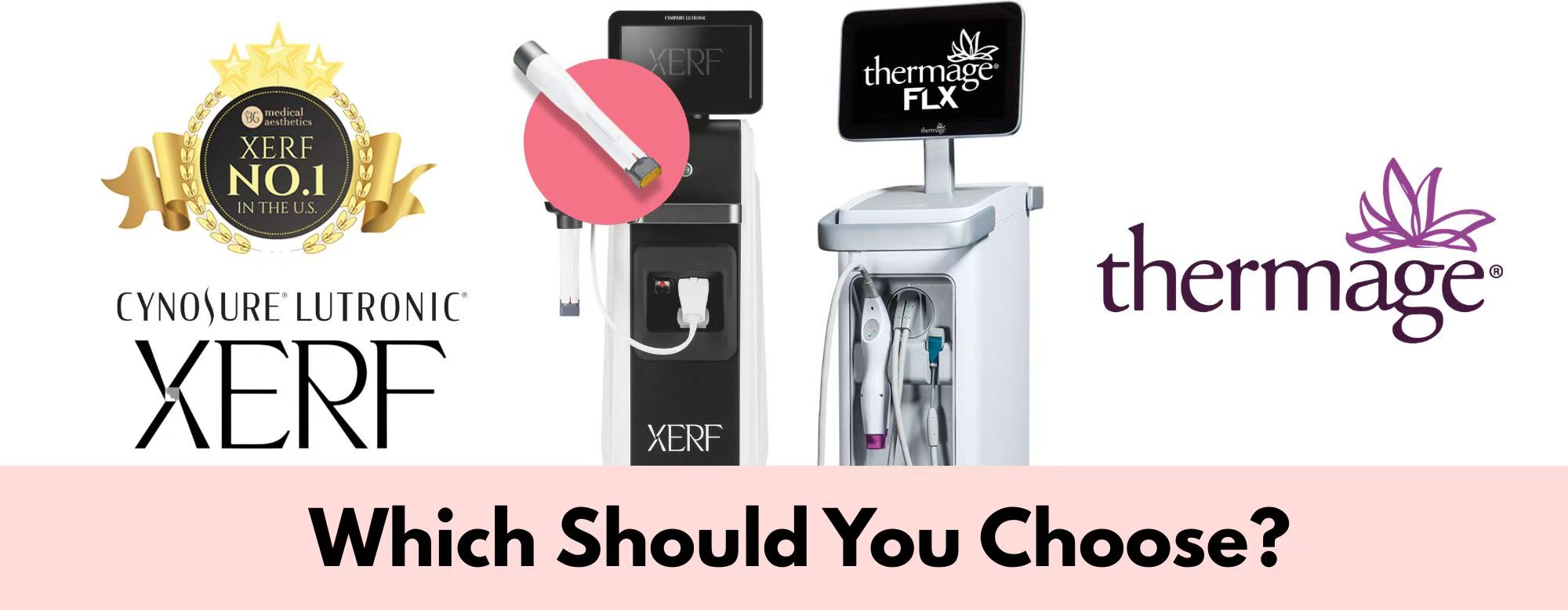
If you’re comparing XERF and Thermage, you’ve already narrowed things down smartly: both are radiofrequency skin tightening treatments, so this is a fair, apples-to-apples comparison RF versus RF, not RF versus ultrasound.
Both heat the skin to stimulate collagen. The real differences are in how they deliver that heat, how many depths they reach, comfort, session count and cost. Here’s the honest breakdown.
- Thermage — single-frequency monopolar RF that heats the dermis broadly and evenly (volumetric heating). One session, long track record, very comfortable, best for overall skin quality and surface tightening.
- XERF — dual-frequency monopolar RF that delivers two frequencies at once, treating two depths in a single pass, with real-time impedance adjustment. Comfortable, no downtime, often shows same-day change, well suited to jawline and lower-face contour.
Neither is universally “better.” They’re tuned for slightly different goals.
Thermage: volumetric dermal heating
Thermage is a well-established monopolar RF device that heats the dermis and upper subcutaneous tissue roughly 2–3mm with diffuse, even heating across the treated zone. Think of it as tightening fabric uniformly. It’s typically a single session, has the longest track record of any RF tightening device, and Thermage FLX is genuinely comfortable thanks to its vibrating comfort tip and cooling. It’s FDA-cleared for the treatment of wrinkles.
XERF: dual-frequency, two depths in one pass
XERF is a next-generation monopolar RF device from Cynosure Lutronic the first to fire two frequencies simultaneously:
- 6.78 MHz treats the upper dermis for surface tightening and texture
- 2 MHz reaches deeper, toward the fibrous septa
Real-time impedance feedback reads tissue resistance and adjusts output zone by zone, and integrated cooling keeps it comfortable, usually with no numbing. Existing collagen contracts on heating (the same-day effect), and new collagen builds over the following weeks (the lasting effect).
FDA clearance: XERF received 510(k) clearance in August 2025 (K251327) for use in dermatologic and general surgical procedures for electrocoagulation and hemostasis; Cynosure Lutronic states tightening effects occur via soft tissue coagulation. Using a cleared device for aesthetic application is ordinary dermatologic practice.
| Feature | Thermage FLX | XERF |
|---|---|---|
| Energy | Single-frequency monopolar RF | Dual-frequency monopolar RF (6.78 + 2 MHz) |
| Heating pattern | Volumetric, dermis ~2–3mm | Two depths in one pass |
| Real-time adjustment | Comfort tip + cooling | Impedance feedback per zone |
| Comfort | Very comfortable (vibrating tip) | Comfortable; usually no numbing |
| Downtime | Minimal | None to minimal |
| Sessions | Often 1 | Often 2, spaced 4–6 weeks |
| Same-day change | Gradual | Often visible |
| Track record | Longest of RF devices | Newer; launched 2024, FDA-cleared 2025 |
| Best for | Overall skin quality, surface tightening | Jawline & lower-face contour, multi-depth tightening |
| Typical cost | ~$2,000–$4,500 | ~$1,500–$3,000/session |
FDA indications and specs per manufacturer as of mid-2026; verify current clearances. Prices are typical U.S. ranges, not advertised prices.
Which Should You Choose?
Thermage may suit you if you want overall skin-quality improvement and surface tightening across a broad area, prefer a single session, and value the longest track record.
XERF may suit you if you want jawline and lower-face definition, multi-depth RF tightening with real-time adjustment, often-visible same-day change, and a comfortable no-downtime session.
And they’re not mutually exclusive over time. Some patients use one and later try the other, or alternate as part of a longer-term plan. That’s a consultation conversation.
The honest constant: with any RF device, the provider’s assessment of your laxity and how they set energy and depth for your face matters as much as the device.
When RF Tightening Isn’t the Answer
Neither XERF nor Thermage replaces a facelift. Significant laxity, heavy jowls, excess folding skin or marked neck banding will get a better result from surgery, and we’ll say so.
And if your real concern is volume loss (filler or biostimulators) or pigmentation (laser), no RF device is the right tool.
Contraindications include pregnancy or breastfeeding; a pacemaker or other implanted electronic device (a specific RF concern); metal implants or permanent filler in the treatment area; active infection; keloid history; certain autoimmune conditions; and impaired wound healing. Assessed at consultation; not exhaustive.
Why Patients Choose BG Medical Aesthetics & Beautiful Glow
We focus on radiofrequency treatment and have performed more than 500 XERF treatments. We assess laxity by zone before recommending anything, customize energy and technique to your anatomy, and tell you honestly when Thermage, a combination, or surgery would serve you better than XERF.
We’re in San Gabriel, serving Los Angeles, Pasadena, Arcadia, Alhambra, Monterey Park and the greater San Gabriel Valley.
Book a Consultation
The right choice between XERF and Thermage depends on your skin, your laxity and your goals, which is what an in-person assessment is for.
Call 626-282-8822 or Book Online at BG Medical Aesthetics & Beautiful Glow in San Gabriel.
Frequently Asked Questions
Is XERF better than Thermage?
Neither is universally better, both are monopolar RF, but XERF delivers two frequencies at once to treat two depths in a single pass with real-time impedance adjustment, while Thermage heats the dermis volumetrically at a single frequency. Thermage has the longer track record and is very comfortable; XERF adds depth range and often shows same-day change. The right one depends on whether you want overall skin-quality tightening or jawline and lower-face contour.
How long does XERF last?
XERF results commonly last 12–18 months, varying with age, skin quality, sun exposure and lifestyle. Maintenance sessions extend results. Thermage results are similar, often cited at 12–24 months.
Is there downtime with XERF or Thermage?
Both are minimal-downtime treatments. Mild redness or warmth is possible for a few hours. Most patients return to normal activity the same day, with no bruising or peeling.
Who is a good candidate?
Adults with mild-to-moderate skin laxity who want non-surgical tightening and understand results build gradually. Neither is right during pregnancy, for patients with a pacemaker or implanted electronic device, metal implants or permanent filler in the area, or certain other conditions assessed at consultation. Those with significant laxity are usually better served by surgery.