
If you’re researching non-surgical skin tightening in Los Angeles or San Gabriel, three treatments come up again and again: XERF, Thermage and Ultherapy.
All three tighten skin and stimulate collagen. All three are non-surgical. And all three genuinely work. But they use different energy, reach different depths, feel different, and suit different concerns, so the useful question isn’t “which is best,” it’s “which is best for what you’re trying to fix.“
Here’s the honest comparison, including where each one wins and where it doesn’t.
- Thermage heats the dermis broadly and evenly with radiofrequency. Comfortable, longest track record, best for overall skin quality and surface tightening.
- Ultherapy uses image-guided ultrasound to reach three depths including the SMAS, the deep layer a surgeon addresses in a facelift. It’s the only device FDA-cleared for non-invasive lifting with real-time visualization, and the strongest choice for structural lifting in the right candidate. Trade-off: less comfortable.
- XERF uses dual-frequency radiofrequency to treat two depths in a single pass, with strong cooling for comfort and no downtime. Best for patients who want multi-depth RF tightening and contour comfortably, often with visible same-day change.
No single one wins every category. Below is why.
Why Depth Matters
Aging isn’t skin-deep. It happens in layers:
- Dermis — collagen loss drives fine lines, texture change and surface laxity
- Subcutaneous fat — compartments deflate and descend, shifting contour
- SMAS (superficial musculoaponeurotic system) — the deep structural layer; when it weakens, the face sags from its foundation
Different energy reaches different layers, which is the real reason these three treatments produce different results. It’s also why, for some patients, the honest answer is a combination rather than any one device.
XERF: Dual-Frequency Radiofrequency
XERF is a next-generation monopolar RF treatment from Cynosure Lutronic, the first to deliver two frequencies at once:
- 6.78 MHz targets the upper dermis for surface tightening and texture
- 2 MHz reaches deeper tissue, toward the fibrous septa
Existing collagen contracts when heated (the same-day effect), and fibroblasts build new collagen over the following weeks (the lasting effect).
What sets XERF apart:
- Two depths treated in a single pass
- Real-time impedance feedback that adjusts output to each tissue zone
- Strong integrated cooling for comfort, usually no numbing needed
- No downtime
- Often-visible same-day tightening
FDA clearance: XERF received 510(k) clearance in August 2025 (K251327) for use in dermatologic and general surgical procedures for electrocoagulation and hemostasis; Cynosure Lutronic states that tightening effects occur via soft tissue coagulation. Using a cleared device for aesthetic application is ordinary dermatologic practice.
Thermage: Volumetric Dermal Heating
Thermage is a well-established monopolar RF treatment that heats the dermis and upper subcutaneous tissue, roughly 2–3mm — with diffuse, volumetric heating. Rather than targeting one plane, it warms a broad zone evenly, like tightening fabric across its whole surface.
Strengths:
- Long clinical track record
- Typically a single session
- Effective for overall skin quality and mild-to-moderate surface laxity
- Thermage FLX is generally the more comfortable of the two established devices, thanks to its vibrating comfort tip and cooling
Consider the trade-offs:
- Heats primarily the dermal zone rather than deep structural layers
- Results are gradual, as with all collagen-based treatments
Thermage is FDA-cleared for the non-invasive treatment of wrinkles.
Ultherapy: Image-Guided Ultrasound to the SMAS
Ultherapy uses microfocused ultrasound with visualization (MFU-V), and the “visualization” part is its signature. It’s the only FDA-cleared device that lets the provider see the tissue layers on a monitor in real time before delivering energy.
It treats at three depths — 1.5mm, 3.0mm and 4.5mm, reaching from the superficial dermis down to the SMAS at 4.5mm, the same structural layer addressed in a surgical facelift. It creates precise thermal coagulation points that trigger collagen contraction and remodeling.
Strengths:
- Reaches the SMAS, the deepest target of the three
- Real-time imaging places energy accurately and helps avoid vessels and bone
- The only device of the three FDA-cleared for non-invasive lifting (brow, neck, submentum)
- Widely regarded in the clinical literature as the gold standard for non-surgical lifting
Consider the trade-offs:
- Generally the least comfortable of the three; the focused pulses create brief, intense deep-heat sensations, especially over bony areas
- Best suited to genuine structural laxity rather than surface concerns
Side by Side
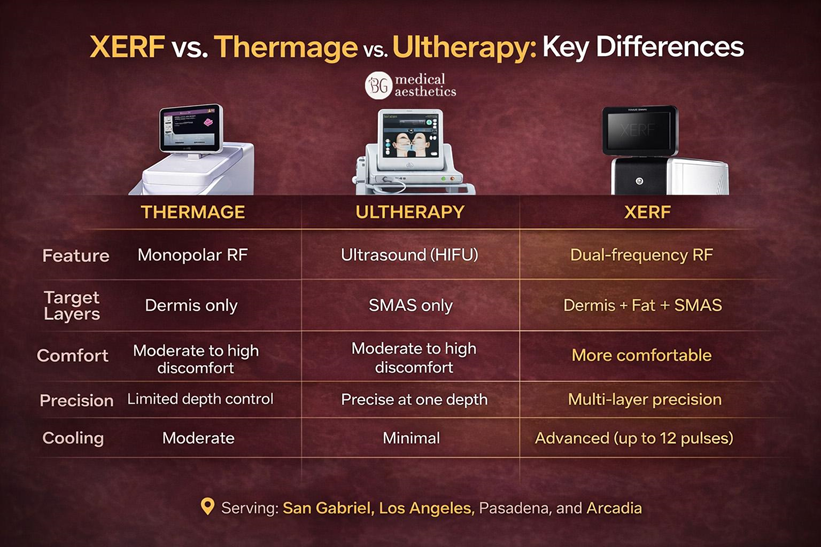
| Feature | Thermage FLX | Ultherapy | XERF |
|---|---|---|---|
| Energy | Monopolar RF | Microfocused ultrasound (MFU-V) | Dual-frequency monopolar RF |
| Depths | Dermis, ~2–3mm, volumetric | 1.5 / 3.0 / 4.5mm, incl. SMAS | Two depths, 6.78 + 2 MHz, one pass |
| Real-time imaging | No | Yes (DeepSEE) | No; impedance feedback instead |
| FDA aesthetic clearance | Wrinkle treatment | Non-invasive lifting (brow, neck, submentum) | Electrocoagulation & hemostasis |
| Comfort | More comfortable | Least comfortable | Comfortable; usually no numbing |
| Downtime | Minimal | Minimal; possible swelling/welts | None to minimal |
| Sessions | Often 1 | Often 1 | Often 2 |
| Results peak | ~2–6 months | ~2–3 months, lasting 12–18 mo | ~2–3 months, lasting 12–18 mo |
| Best for | Surface tightening, skin quality | Structural SMAS lifting | Comfortable multi-depth RF tightening |
FDA indications and specifications per manufacturer and published literature as of mid-2026. Verify current clearances with each manufacturer.
So Which Should You Choose?
Choose Thermage if your main concern is overall skin quality and mild surface laxity across a broad area, you want a single comfortable session, and you value a long track record.
Choose Ultherapy if you have genuine structural laxity and want the deepest, image-guided lifting with an actual FDA lifting clearance and you can tolerate a less comfortable session.
Choose XERF if you want multi-depth RF tightening and contour in a comfortable, no-downtime session, you value often-visible same-day change, and you’d rather not be numbed.
And sometimes the answer is a combination. Some patients benefit from ultrasound for deep lifting plus RF for dermal tightening and skin quality sequenced across separate sessions. That’s a consultation conversation, not a webpage decision.
The device sets the ceiling. The provider’s assessment of your laxity, at which depth, determines the result.
When Skin Tightening Isn’t the Answer
None of these three replaces a facelift. If you have significant laxity, heavy jowls, excess skin that folds, or marked neck banding, a surgical consultation will serve you better, and we’ll say so.
And if your real concern is volume loss (filler or biostimulators) or pigmentation (laser), no tightening device XERF, Thermage or Ultherapy, is the right tool.
Contraindications for energy-based tightening include pregnancy or breastfeeding; a pacemaker or other implanted electronic device (a specific concern for RF); metal implants or permanent filler in the area; active infection; keloid history; certain autoimmune conditions; and impaired wound healing. Ultrasound and RF have different specific considerations, this is assessed at consultation. Not exhaustive; not a substitute for medical evaluation.
Cost in Los Angeles & San Gabriel
All three are cosmetic and not covered by insurance. Published U.S. ranges as of mid-2026:
- Thermage — roughly $2,000–$4,500 depending on area
- Ultherapy — roughly $2,000–$5,000 depending on area treated
- XERF — roughly $1,500–$3,000 per session; full face and neck often ~$2,500
Los Angeles County generally runs above national averages, and protocols differ (XERF often two sessions; Thermage and Ultherapy often one), so compare total plan cost. We provide an exact written quote at consultation.
Why Patients Choose BG Medical Aesthetics & Beautiful Glow
We focus on radiofrequency treatment and have performed more than 500 XERF treatments. Our approach:
- Assess your laxity by zone and depth before recommending anything
- Tell you honestly when Ultherapy, Thermage, a combination, or surgery would serve you better than XERF
- Customize energy and technique to your anatomy
- Preserve facial volume, XERF is calibrated to tighten skin without affecting the fat that gives your face its shape
We’re in San Gabriel, serving Pasadena, Arcadia, Alhambra, Monterey Park and the greater Los Angeles area.
Book a Consultation
The right choice among XERF, Thermage and Ultherapy depends on your skin, your laxity and its depth, which is what an in-person assessment is for.
Call 626-282-8822 or book online to schedule a consultation at BG Medical Aesthetics & Beautiful Glow in San Gabriel.
Frequently Asked Questions
Is XERF better than Ultherapy?
Neither is universally better, they use different energy for different goals. Ultherapy uses image-guided ultrasound to reach the SMAS at 4.5mm and holds an FDA lifting clearance, making it the stronger choice for deep structural lifting. XERF uses dual-frequency RF at two depths in a comfortable, no-downtime session and often shows same-day change. The right one depends on whether your concern is structural laxity or overall tightening and contour.
Is XERF better than Thermage?
They’re both monopolar RF, but XERF delivers two frequencies simultaneously for multi-depth treatment in one pass, while Thermage heats the dermis volumetrically at a single depth range. Thermage has the longer track record and is very comfortable; XERF adds depth range and real-time impedance adjustment. Neither is simply “better.”
Which is the most comfortable?
Generally XERF and Thermage FLX are more comfortable than Ultherapy. Ultherapy’s focused ultrasound creates brief, intense deep-heat sensations, especially over bony areas. XERF’s strong cooling means most patients need no numbing.
Which lasts longest?
All three produce gradual collagen-based results lasting roughly 12–18 months, varying with age, skin quality and lifestyle. Maintenance sessions extend results for any of them.
Can you combine them?
Yes, some patients benefit from ultrasound for deep lifting plus RF for dermal tightening, sequenced across separate sessions rather than combined in one. This is planned at consultation.
Which is best for the jawline?
It depends on the cause. For deep structural jawline laxity, Ultherapy’s SMAS targeting is a strong option. For dermal tightening and contour with more comfort, XERF is well suited. Heavy, established jowls generally need surgery regardless of device.